Aluminium Panel

All about WUFI Pro
Post Reply
Alberto Morales
WUFI User
WUFI User
Posts: 86
Joined: Tue Mar 29, 2022 10:57 pm -1100

Aluminium Panel

Post by Alberto Morales »

Hi,

how should I model the aluminum panel in WUFI ?

should I uncheck "Simulation takes into account" and defining proper short-wave absorptivity? what about "additional diffusion resistance" and heat transfer coefficient?
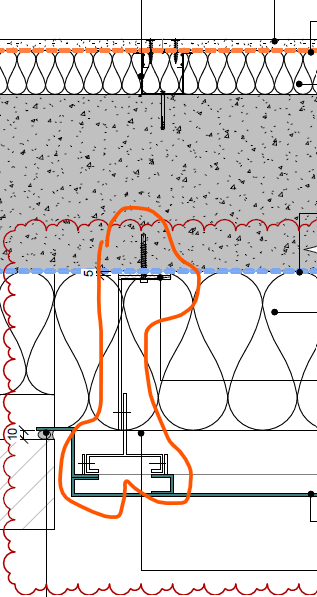
Capture.PNG
Capture.PNG (55.54 KiB) Viewed 1045 times
x
Christian Bludau
WUFI SupportTeam IBP
Posts: 1301
Joined: Tue Jul 04, 2006 10:08 pm -1100
Location: IBP Holzkirchen, the home of WUFI
Contact:

Re: Aluminium Panel

Post by Christian Bludau »

Hi Alberto,

I would recommend leaving the aluminium panel itself out of the assembly and instead accounting for its vapour diffusion resistance through an additional diffusion resistance (sd-value) in the surface transfer conditions.

For the exterior surface properties, use the short-wave absorptivity and long-wave emissivity of the actual aluminium finish. I would also recommend enabling radiative overcooling, especially if the emissivity is significantly lower than the default value of 0.9.

The heat transfer coefficient can generally be left at the standard exterior value unless you have specific measurements or project requirements that justify a different setting.

Christian
Alberto Morales
WUFI User
WUFI User
Posts: 86
Joined: Tue Mar 29, 2022 10:57 pm -1100

Re: Aluminium Panel

Post by Alberto Morales »

thanks for the reply once again.

what is the difference between Aluminum bright, wet and dry? they have different long-wave emissivity.

should I keep checked the option "Simulation take rain into account"? As the aluminum panel will not absorb rain at all. this idea is also shared here... https://wufi.de/en/service/wufi-forum/? ... ea70f905d8. when I define sd for metal panel as 9999999, there is no result difference if I unckeck the "rain absorption" or not...I guess the software does it itself, am I right? I get a warning message if I don't unchecked when I define a sd value for external surface

if no data available for short wave absorptivity and long wave emissivity, which values should I use as a standard for typical aluminum façade cladding? because it is highly probable that the manufacturer is not able to provide that info and as you said having low or high long wave emissivity will make a difference as we don't or do select radiative overcooling option.

Could the RCmin criteria for fiber insulation (e.g. mineral wool) (100g/m2 WC) be used to assess potential run off for this case although I don't have a water and vapor tight surfaces in between both layers? if not, what is the criteria to follow? as if I can see the WC at 80%RH in the material data is given me 1.79 kg/m3 for 180mm layer thickness for mineral wool. if yes, should I follow "Guideline for assessing the risk of interstitial condensation runoff"?
Capture.PNG
Capture.PNG (67.1 KiB) Viewed 955 times
x
Christian Bludau
WUFI SupportTeam IBP
Posts: 1301
Joined: Tue Jul 04, 2006 10:08 pm -1100
Location: IBP Holzkirchen, the home of WUFI
Contact:

Re: Aluminium Panel

Post by Christian Bludau »

Hi Alberto,

Aluminum bright, dry vs. wet
The different long-wave emissivities are based on measurements from a research project and reflect the fact that bright aluminum behaves very differently when its surface is dry or covered by a thin water film. In practice, façade surfaces are often intermittently wetted by rain or dew, so the real behavior is usually somewhere in between these two extremes.

For most aluminum façade applications, I would recommend using a long-wave emissivity of about 0.5 as a practical average value. If the cladding consists of clean, uncoated bright aluminum and remains mostly dry, values closer to 0.1 may be appropriate. Lower values are typically laboratory measurements on very clean surfaces and are often not representative of real façades due to ageing, dust, and surface contamination.

"Simulation takes rain into account"
For a metal façade, I would recommend disabling "Simulation takes rain into account". A metal surface does not absorb rainwater into the material, so driving rain should not be treated as a surface moisture source.

If water can penetrate behind the cladding, this should be represented using an appropriate rain source at the relevant location in the assembly. This is exactly what the rain source option is intended for.

The reason you see virtually no difference in the results is probably that the selected surface material does not contain any liquid transport properties in the material dataset. In that case, WUFI cannot absorb liquid water from driving rain, regardless of whether the option is enabled or disabled. Therefore, the rain load has no practical effect on the simulation results.

Radiation properties if no manufacturer data are available
For uncoated bright aluminum, I would use the following default values:

Short-wave absorptivity: a = 0.25
Long-wave emissivity: ε = 0.5 (representing a realistic in-service condition)

Assessment of potential runoff / interstitial condensation

You can use the "Guideline for Assessing the Risk of Interstitial Condensation Runoff" for this evaluation.

In your case, the key question is whether the underlying insulation layer is capable of storing the accumulated moisture. If the underlying layer can safely absorb and redistribute the condensate, the assessment will generally not indicate a runoff risk.
Christian
Alberto Morales
WUFI User
WUFI User
Posts: 86
Joined: Tue Mar 29, 2022 10:57 pm -1100

Re: Aluminium Panel

Post by Alberto Morales »

Thanks once again for your explanation. I really appreciate it.

1- If I follow the guideline on “Assessing the Risk of Interstitial Condensation Runoff,” what minimum RC value should I consider? I ask because I do not have a water- and vapour-tight surface in my assembly, and I do not consider it would be appropriate to consider the concrete layer as one (correct me if I am wrong, I have seen projects that concrete layer is used as a airtightness layer reaching lower ach in blower door test with this strategy).

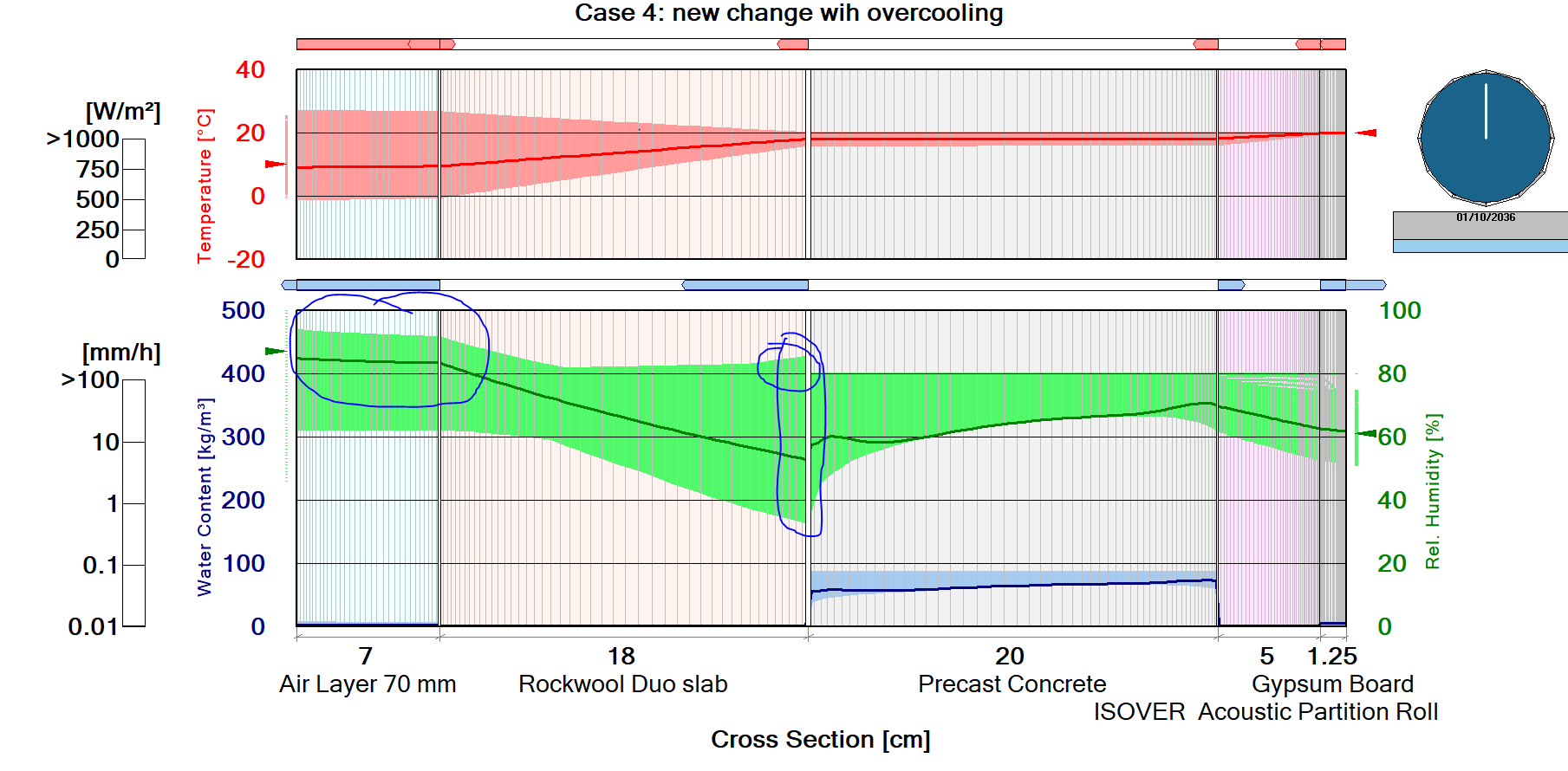
2- Also, if there is no risk of interstitial condensation runoff, does that necessarily mean that the assembly will not experience moisture-related issues, even if the RH in the unventilated air cavity and at the outer side of the insulation remains above 80%, as shown in the image?

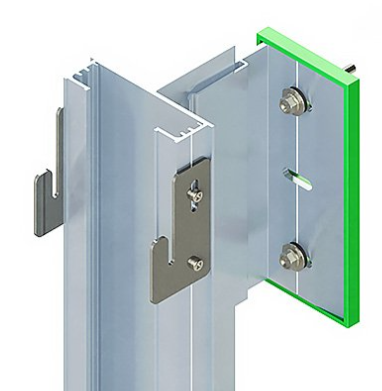
3- One other point I am concerned about is the area I have highlighted in the image. The aluminum carrier rails have a protective oxide layer, but can corrosion still occur under certain environmental conditions, particularly if the RH remains high for extended periods as showed in the WUFI film? Can interstitial condensation in the outer part of the external insulation to move inwards through this aluminum carrier rails? as If yes, how to prevent it as I do not have any breather membrane.

4- If the air cavity is ventilated, should I keep considering the sd value, long wave and short wave properties of the aluminum panel? As the effective hygrothermal behaviour is governed by the open joints + ventilated cavity, not by diffusion through the aluminum (the aluminum itself is essentially vapour-impermeable)

I would appreciate your thoughts on these points.
1.PNG
1.PNG (169.37 KiB) Viewed 825 times
Screenshot 2026-08-27 084509.png
Screenshot 2026-08-27 084509.png (63.23 KiB) Viewed 825 times
Screenshot 2026-08-27 084410.png
Screenshot 2026-08-27 084410.png (117.3 KiB) Viewed 825 times
x
Alberto Morales
WUFI User
WUFI User
Posts: 86
Joined: Tue Mar 29, 2022 10:57 pm -1100

Re: Aluminium Panel

Post by Alberto Morales »

Could the "Assessing the Risk of Interstitial Condensation Runoff" guideline be applied for a foil face PIR insulation which is between an unventilated cavity and concrete? what would it need to be modified in the definition of a foil faced PIR in WUFI due to low-emissivity (low-e) surface of aluminum foil? As my ventilated air cavity is 50 mm, how should I calculate lambda* and µ* base on the explanation of the section "Determining the effective transport parameters" in WUFI help for an air cavity facing in the inner side to a foil faced PIR?
x
Post Reply